How institutions stake ETH: native, liquid and vault routes compared
Native staking, liquid staking and staking vaults differ in who can start an exit, how long getting ETH back takes, what the books show and where concentration builds. In every route, validators leave through the same protocol exit queue; a liquid pool can pay a redemption from ETH it already holds when it has enough. On October 22, 2026, a 50,000 ETH native exit would have taken up to about 10.5 days, and up to about 24 days at the peak of October 2. The route comes before the choice of operator, and the questions at the end work for any provider.
By Develp
Listed funds and treasury companies now stake ETH, and the first decision they face is the route, before the choice of operator. The three routes are native staking, liquid staking and staking vaults. They differ in who can start an exit, how long it takes to get ETH back, what the books and reports show and where concentration builds. This guide sets them side by side and follows a 50,000 ETH exit through each. It ends with questions that can go to any provider, Develp included.
On October 6, 2025, Grayscale's ETHE and ETH became the first U.S.-listed spot crypto ETPs to enable staking. A year later, the treasury company Bitmine reported 5,067,309 of its 6,028,946 ETH staked as of October 11, 2026.
The three routes at a glance
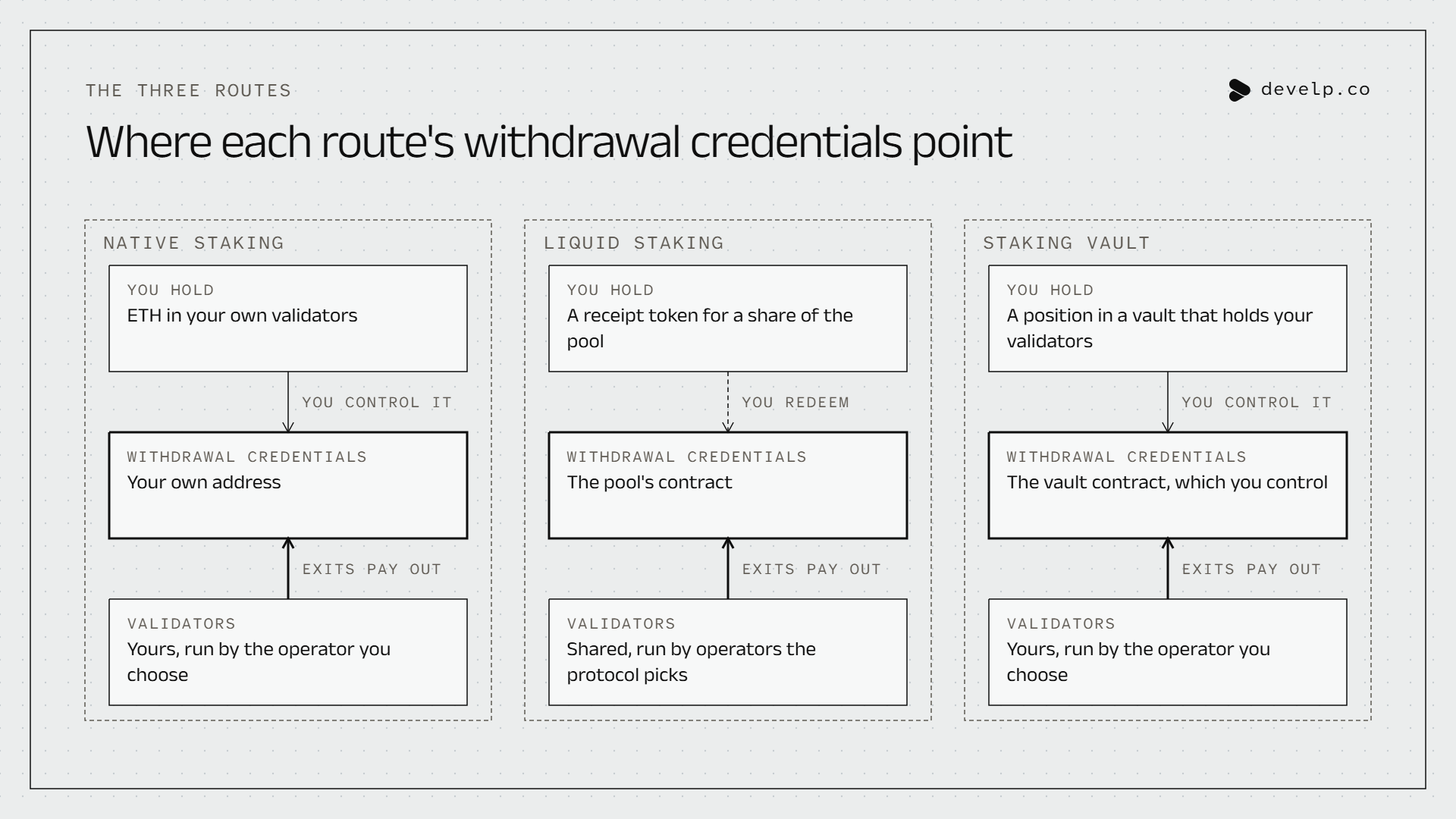
Native staking means validators whose withdrawal credentials point to an address the institution controls. The withdrawal credentials decide where a validator's ETH goes when it leaves. Liquid staking means depositing ETH into a pool and holding a receipt token for a share of it. A staking vault is a contract that holds only the institution's validators, run by an operator it chooses.
| Native staking | Liquid staking | Staking vault | |
|---|---|---|---|
| What you hold | ETH in your own validators | A receipt token for a share of the pool | A position in a vault contract that holds your validators |
| Where the withdrawal credentials point | Your own address | The pool's contract | The vault contract, which you control as owner |
| Who picks the operator | You | The protocol and its governance | You |
| Who can start an exit | You, through your withdrawal address, and the operator with the signing keys | You can request a redemption; exits are up to the pool and its operators | You, through the vault contract, and the operator with the signing keys |
| How ETH comes back | The exit queue, then the withdrawal sweep | From the pool's available liquidity or after validator exits, or by selling the token | The exit queue and the sweep, through the vault |
| What comes off the rewards | The operator's fee | The protocol's fee | The operator's fee and any vault fee |
| What reporting shows | Each validator's balance, rewards and duties on chain | A token balance or exchange rate | Each validator on chain, plus the vault's own accounts |
| Where concentration builds | Your operator's software clients, regions and relays | The pool's operator set, contracts and governance | Your operator, plus the vault's code |
Across the network, a large share of stake sits with a few entities. On October 22, 2026, Miga Labs tracked 773 staking entities, and the 10 largest held 44.7% of stake, with validators it could not attribute counted as their own operators. The 10 include exchanges, liquid staking protocols, staking providers and a treasury company staking its own ETH.
Native staking: your validators, your withdrawal address
In native staking, the institution's validators carry withdrawal credentials that point to an address it controls. Each validator can be given a withdrawal address only once, and once it is on chain it can't be changed. That makes it the part of the setup most worth checking before the first deposit.
Since the Pectra upgrade of May 7, 2025, that address can also act on its own. Under EIP-7002, it can trigger a full exit of any of its validators without the operator's signing key. It can take a partial withdrawal, part of the balance without an exit, only from validators with compounding (0x02) credentials. These are the newer kind, which keep rewards in the validator instead of paying them out. The older 0x01 kind has any balance above 32 ETH paid out automatically. A validator with 0x01 credentials can still be switched to 0x02 by its withdrawal address, which stays the same. The operator runs the signing keys, and the institution keeps the withdrawal credentials.
Exits work from the operator's side as well. The protocol accepts a voluntary exit signed with the validator's own key, so the operator, which runs those keys, can exit the validators too. An operator's exit policy is therefore worth knowing: when it would exit without an instruction, and how the institution would hear about it.
Pectra also changed validator size. A validator still needs 32 ETH to activate. Under EIP-7251, one with 0x02 credentials can hold up to 2,048 ETH, and existing validators can be consolidated, merged into one. Fewer, larger validators mean fewer keys to manage.
Reporting is direct. Every validator's balance, rewards and duties are recorded on chain, so the stake can be checked independently of the operator's own reports. On the books, KPMG's April 2026 Hot Topic on staking, written for US GAAP, says staked tokens generally stay on the staking entity's balance sheet. Staking through a custodian doesn't change that, in KPMG's view, when the owner controls when and whether to stake and unstake.
For a treasury, native staking keeps the exit closest to the institution. It also means the operator's setup becomes the institution's own exposure from the first deposit. That setup covers the software clients its validators run, the regions they sit in and the relays that bring it blocks from outside builders.
Liquid staking: a receipt token for a share of a pool
In liquid staking, the institution deposits ETH into a protocol, which stakes it with its node operators and issues a receipt token in return. The SEC's March 2026 interpretation calls these "Staking Receipt Tokens". The pool's contracts hold the withdrawal credentials, and the protocol decides which operators receive the stake.
Getting ETH back works in two ways. The token can be redeemed through the protocol, which pays from its available liquidity when it has enough and otherwise waits for validators to leave through the exit queue. The token can also be sold, which is quick, at a price that can differ from the ETH behind it, more so when markets are under stress.
Rewards reach the holder after the protocol's fee. KPMG expects a delegator, its term for a holder who deposits ETH into the pool, to record its staking revenue net of any protocol fees.
The accounting differs too. In KPMG's view, a delegator in liquid staking "will generally derecognize its staked tokens", taking them off its balance sheet, and records the receipt tokens in their place.
How rewards are recorded then depends on the token. Extra receipt tokens paid as rewards are generally treated as revenue received in tokens (variable noncash consideration, in KPMG's terms). A token that grows in value instead may mean no staking revenue is recognized until the delegator redeems. That depends on whether the token falls under US GAAP's crypto asset rules (Subtopic 350-60). KPMG says its views may not be the only acceptable ones, so the treatment is worth settling with auditors before the first deposit.
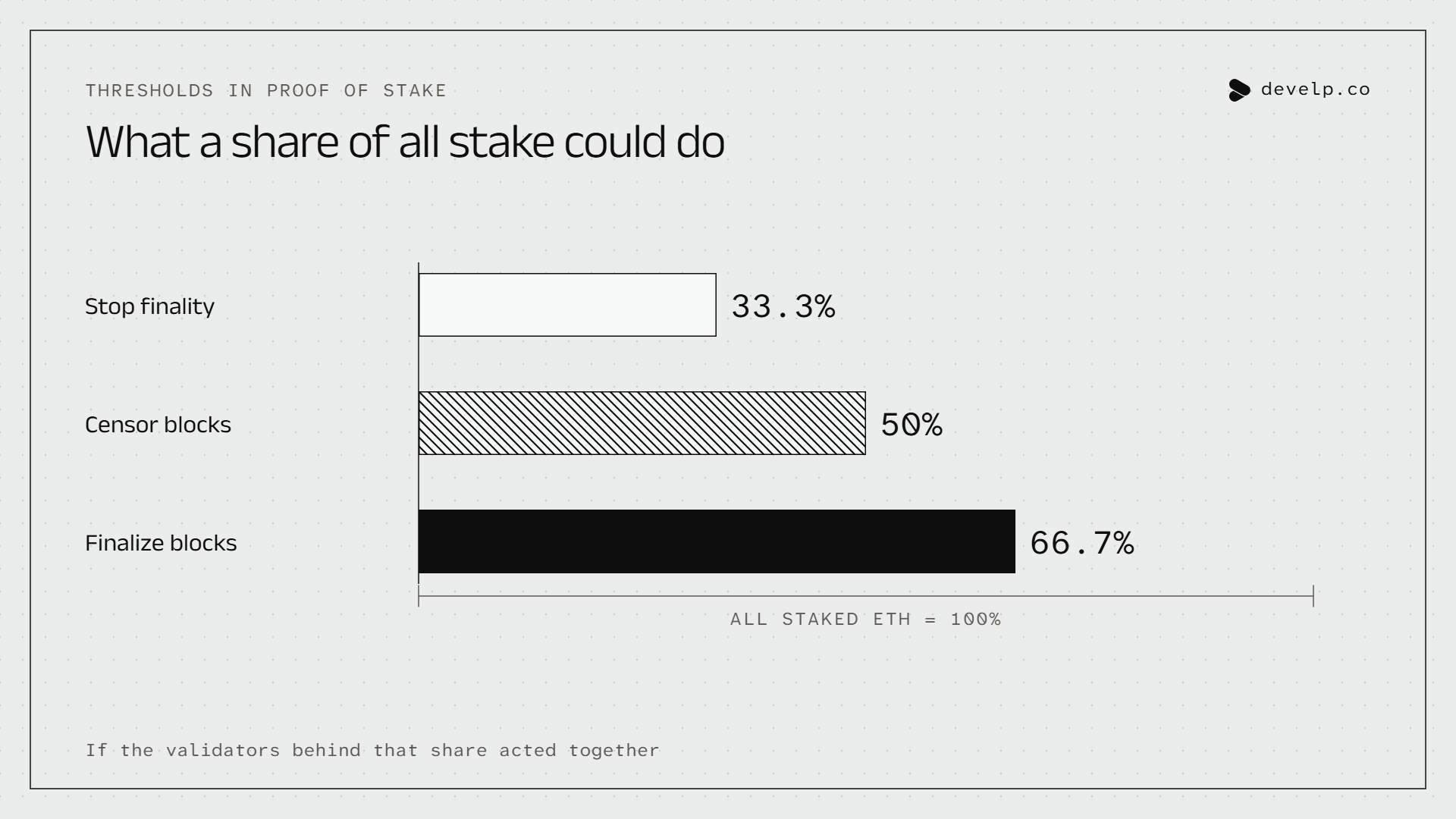
Concentration builds inside the pool. As of August 2026, liquid staking protocols hold around a third of all staked ETH. Miga Labs lists a pool's operators as separate entities, so per-entity shares understate how much stake one pool's contracts and governance oversee. A note on the risks of liquid staking sets out the levels that matter for a single protocol: a third, a half and two thirds of the stake. Above half, pooled stake could censor blocks, and at two thirds it could also finalize them, the step that makes blocks permanent.
A pool's operators hold signing keys too. From September 30, 2026, one operator in a liquid staking pool exited its validators as a precaution after a security incident it disclosed. The exit queue grew from about 166,000 ETH on September 29 to roughly 851,000 ETH by October 2. Exiting as a precaution was a responsible step. It also showed that a single operator in a pool can send a large amount of stake into the queue at once.
For a treasury, liquid staking adds liquidity on top of staking. In exchange, it has less say over the operators, pays a protocol fee and relies on a contract and governance layer in between.
Staking vaults: an isolated position with an operator you choose
A staking vault sits between the two. A contract holds only the institution's validators and is their withdrawal address, and the owner controls deposits, withdrawals and exit requests through it. EIP-7002 was written for this case as well: it lets withdrawal credentials held by a contract trigger exits, as well as those held by an ordinary address. The operator, which the owner chooses, runs the signing keys and can sign a voluntary exit, as in native staking.
Some vault designs let the owner mint a liquid token against the vault's ETH, within collateral rules. While the token is outstanding, the ETH backing it is locked and can't be withdrawn, so the token has to be settled before that part of the stake can leave.
Fees come from two places: the operator, and the protocol behind the vault, if it takes one. Both are worth asking for in writing. Reporting works as in native staking, with each validator's data on chain, plus the vault contract's own accounts.
Concentration sits with the chosen operator's setup and with the vault's code and the protocol behind it. For a treasury, a vault offers control and reporting close to native staking, with an optional liquidity layer and one more contract to review and monitor.
Worked example: a 50,000 ETH exit through each route
Take a treasury with 50,000 ETH staked in validators of 32 ETH each. In every route, the validators leave through the same protocol path. They wait in the exit queue, which lets out 256 ETH per epoch of 6.4 minutes. Once exited, they wait a fixed 256 epochs before they can be withdrawn. Then the withdrawal sweep, which moves through the validator set in order, pays each one within a full cycle.
On October 22, 2026, validatorqueue.com showed 81,767 ETH already waiting to exit and a sweep delay of 7.1 days. On October 2, after the precautionary exits, about 851,000 ETH was waiting. A native exit of 50,000 ETH would have taken this long:
| Step | Oct 22, 2026 | Oct 2, 2026 |
|---|---|---|
| The exit queue ahead | About 34 hours | About 14.8 days |
| The 50,000 ETH's own turn | About 21 hours | About 21 hours |
| The fixed delay before withdrawal | About 27 hours | About 27 hours |
| Time until withdrawable | About 3.4 days | About 17 days |
| The sweep | Up to 7.1 days | Up to 7.1 days, as on Oct 22 |
| In all | Up to about 10.5 days | Up to about 24 days |
Source: validatorqueue.com, Oct 22, 2026; CoinDesk, Oct 5, 2026.
Through a liquid pool, a redemption of the same size depends on the pool. If its available liquidity covers the amount, the ETH can arrive without waiting for any validator to exit. Beyond that, the redemption waits for the pool's validators to go through the same queue, delay and sweep. Selling the receipt tokens is quick, at whatever price the market pays that day.
Through a vault, the owner sends the exit request through the vault contract, and the validators follow the native path, with the same timings. If a token was minted against the vault, it has to be settled first.
EIP-8061, planned for the Glamsterdam upgrade, would tie the exit limit to the total stake. Glamsterdam has no mainnet date yet. At the 42.8 million ETH that Miga Labs counted as active on October 22, 2026, the limit would be about 1,300 ETH per epoch instead of 256. For the exits of October 2, the wait before the sweep would fall from about 17 days to about 4.2 days.
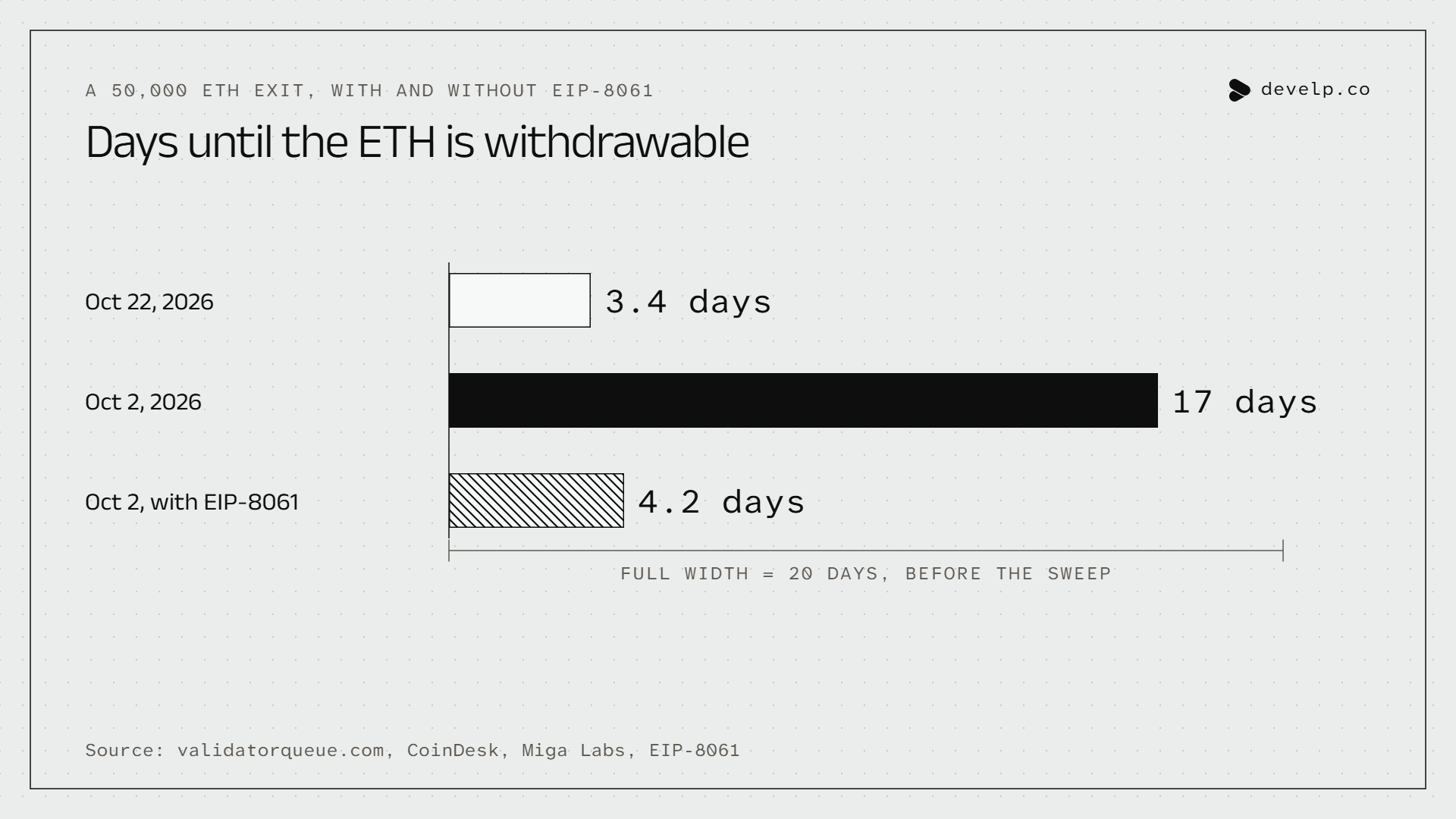
The fixed delay and the sweep stay as they are, and so does entry: activations remain capped at 256 ETH per epoch. On October 22, 2026, the entry queue held 1,345,460 ETH, a wait of about 23 days.
BlackRock plans around these times in writing. Its iShares Staked Ethereum Trust aims to keep 5% to 30% of its ETH unstaked for redemption requests. Its liquidity risk policy, last updated in January 2026, counts the protocol's exit and entry times among the factors that set that share.
What each route doesn't do
Liquid staking doesn't make every exit fast. Redemptions beyond the pool's available liquidity wait on the exit queue, and a token sale is quick only at the market's price. A vault doesn't remove contract risk, since it adds a contract between the institution and its validators. Native staking doesn't remove operator risk, because the operator runs the signing keys and can exit the validators.
Well-run operators earn within a narrow range of each other. Between routes, the difference lies in the fees taken before rewards reach the holder. That is the operator's fee in native staking, the protocol's fee in liquid staking and the operator's fee plus any vault fee in a vault.
The regulatory frame, briefly
In the United States, the SEC set out its view in an interpretive release issued with the CFTC, effective March 23, 2026. It covers four kinds of staking: solo staking, self-custodial staking with a third party, custodial arrangements and liquid staking. In self-custodial staking with a third party, the staker keeps custody of its assets. Under the conditions it describes, it concludes that these activities "do not involve the offer and sale of a security". It addresses only the kinds of staking it describes, and it replaces the SEC staff's statements of May and August 2025 on the same topics.
Readers outside the U.S. may want to check the rules where they are, and any institution may want its own counsel's view.
Questions to take to any provider
Whichever route a treasury takes, a few questions turn this comparison into a decision. They work for any provider.
- For native staking: where do our withdrawal credentials point, are they 0x01 or 0x02 and how would we send an exit request from that address ourselves?
- For liquid staking: who adds and removes the pool's operators, how much liquidity it keeps for redemptions and how it handled redemptions in the last period of heavy exits?
- For a vault: who can exit the validators, who can upgrade the contract and what happens to a minted token when we exit?
- For any route: when would the operator exit our validators without an instruction from us, and how would we hear about it?
- What fees come off the rewards before they reach us, and who takes each one?
- Which software clients, regions and relays carry our stake, and what does each month's report show per validator?
Choosing the route and the setup before the first deposit costs nothing extra, while changing them later means exiting, waiting for the withdrawal and queuing to enter again. If it would help to go through these questions for your own setup, we'd be glad to: talk to our team.
Questions
Can we move from one route to another later?
Yes, though leaving native staking or a vault takes time. The validators go through the exit queue, the fixed delay and the sweep. The ETH then waits in the entry queue, earning nothing until it is active. On October 22, 2026, a 50,000 ETH exit would have taken up to about 10.5 days, and the entry queue was a wait of about 23 days. A liquid staking position can also be redeemed from the pool's available liquidity or sold, which can be faster. Either way, the route is worth settling before the first deposit.
Who controls the exit in each route?
The address or contract behind the withdrawal credentials can always force an exit. That is your own address in native staking and the vault contract you control in a vault. In liquid staking it is the pool's contract, and you redeem through the protocol. The operator holding the signing keys can exit the validators too, so its exit policy is worth asking about.
Is a liquid staking token the same as ETH on the balance sheet?
Not in KPMG's April 2026 view under US GAAP. A delegator in liquid staking will "generally derecognize its staked tokens", taking them off its balance sheet, and records the receipt tokens instead. KPMG says its views may not be the only acceptable ones, so the treatment is a question for your auditors.
Does a vault need its own review and monitoring?
It's worth it. A vault adds a contract between the institution and its validators. The contract's audits, who can upgrade it and how its accounts are reported belong in the diligence, next to the operator's setup.
Can a fund split its stake across routes?
Yes. One fund already keeps part of its ETH unstaked: BlackRock's staked ETH trust aims to keep 5% to 30% unstaked for redemptions. A treasury could hold most of its stake natively and a smaller share in liquid staking, or split it between two operators with different setups. Which split fits depends on the institution.
Sources
- Grayscale press release on staking for ETHE and ETH (SEC filing), Grayscale, 2025-10-06
- Bitmine Immersion Technologies announces ETH holdings reach 6.03 million tokens, Bitmine (PR Newswire), 2026-10-12
- Ethereum Staking Entities, Miga Labs, 2026-10-22
- EIP-7002: Execution layer triggerable withdrawals, Ethereum Improvement Proposals
- EIP-7251: Increase the MAX_EFFECTIVE_BALANCE, Ethereum Improvement Proposals
- Hot Topic: Accounting for staking activities (April 2026), KPMG, 2026-04
- Statement on Certain Liquid Staking Activities, SEC, Division of Corporation Finance, 2025-08-05
- Pooled staking, ethereum.org, 2026-08-17
- The Risks of LSD, notes.ethereum.org
- Ethereum has a 25-day wait to start staking, with nearly 1.5 million ETH in line, CoinDesk, 2026-10-05
- Validator Queue, validatorqueue.com, 2026-10-22
- EIP-8061: Increase exit and consolidation churn, Ethereum Improvement Proposals
- iShares Staked Ethereum Trust ETF: Ethereum Staking Liquidity Risk Policy, iShares Delaware Trust Sponsor (BlackRock), 2026-01
- Statement on Certain Protocol Staking Activities, SEC, Division of Corporation Finance, 2025-05-29
- Application of the Federal Securities Laws to Certain Types of Crypto Assets and Certain Transactions Involving Crypto Assets (Release Nos. 33-11412; 34-105020), SEC and CFTC (Federal Register), 2026-03-23